How to Build Lasting Habits: The Science of Sustainable Change
By Osvaldo Morales
Many people struggle to maintain new habits, whether exercising regularly, eating healthier, or improving productivity. What they don’t understand is that motivation will not be enough. The key to lasting habit formation lies in understanding the psychological mechanisms behind behavior change and applying strategies that work with our brains, not against them. Psychological research has identified practical approaches to making habits stick. By structuring habits effectively and adjusting our environment, we can develop routines that last.
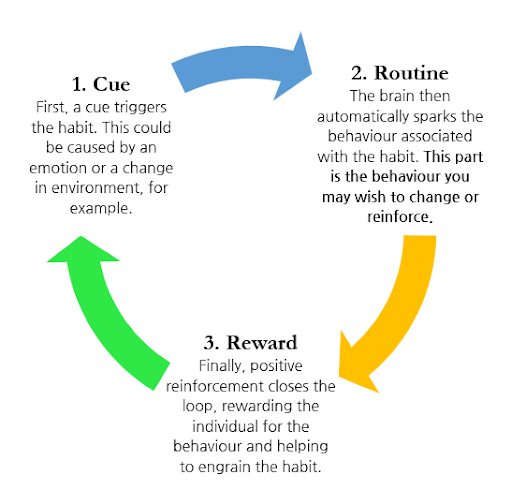
Psychologists define habits as automatic responses to specific situations. Research shows that habits develop through repeated behavior in a consistent setting, making them resistant to change (Wood & Neal, 2007). Habits work through a loop of three forms, cues, behaviors, and rewards. The more this loop repeats, the more automatic the behavior becomes. Understanding this cycle enables someone to intentionally create positive habits while breaking harmful ones (Bailey, 2024).
To build strong habits, use implementation intentions such as planning when and where they occur. Gollwitzer (1999) found that "if-then" statements significantly improve habit success. Instead of saying you will “exercise more,” you should tell yourself, “At 7 AM, I will do 10 push-ups in my bedroom.” or “When I finish eating lunch, I will go for a 10-minute walk.” These cue-based intentions increase the automaticity of a habit by linking them to pre-existing behaviors or time-based triggers.
Second, to build good habits, make them easy. Research shows that the less effort a behavior requires, the more likely the chance that it’ll become a habit (Wood & Neal, 2007). Reduce the difficulty for good habits like setting out gym clothes the night before to encourage workouts. Increase difficulty for bad habits like keeping your phone in another room to limit distractions. Structuring your environment this way helps habits form naturally.
Thirdly, use habit stacking by attaching new habits to existing ones. Since habits are cue-driven, linking a new behavior to an ingrained routine makes it easier to adopt (Bailey, 2024). For example, after brushing your teeth, floss one tooth, or after pouring coffee, write down something you’re grateful for. This method increases consistency by using established habits (Positive Psychology, n.d.).
Research indicates that self-monitoring increases the likelihood of behavior change which is the fourth thing you can do. Tracking habits builds momentum and reinforces commitment (Bailey, 2024). Methods to track habits include using habit-tracking applications, keeping a journal, and recording progress on a calendar tracking also produces the streak effect, where visible progress encourages continued participation and engagement (Positive Psychology, n.d.).
Finally, rewarding yourself immediately after completing a habit reinforces its repetition, as the brain wants instant gratification (Wood & Neal, 2007). Since long-term goals are harder to stick with, pairing habits with short-term rewards, like listening to a podcast while working out, makes them more satisfying. Celebrating small wins and recognizing progress will boost motivation and strengthen habit formation.
Just as habits form quickly, they can also be interrupted from their cues. Make bad habits inconvenient, move snacks out of reach, log out of social media, or replace nail-biting with a stress ball. The harder a habit is to perform, the less likely it is to continue.
An important principle of habit research is that minor, consistent changes add up to long-term outcomes. Since habits work automatically, small changes can lead to an immense personal transformation (Wood & Neal, 2007). Reading one page daily could turn into completing multiple books annually. Exercising just 10 minutes a day can lay the foundation for a lifelong fitness routine. Instead of aiming for big changes, focus on small, maintainable actions that reinforce positive habits (Positive Psychology, n.d.).
Building lasting habits isn’t about motivation, it is about using psychology to make habits automatic and more attainable. By using implementation intentions, reducing effort, tracking progress, and reinforcing rewards, anyone can make positive behaviors part of their daily life. The secret isn’t willpower; it’s strategy. By making small, intentional changes, habits become second nature which can help you shape a healthier, more productive future.
References
Bailey, A. (2024). Rewire your habits, rewire your life. Psychology Today. https://www.psychologytoday.com/us/blog/beyond-school-walls/202410/rewire-your-habits-rewire-your-life
Gollwitzer, P. M. (1999). Implementation intentions: Strong effects of simple plans. American Psychologist, 54(7), 493–503. https://psycnet.apa.org/doi/10.1037/0003-066X.54.7.493
Positive Psychology. (n.d.). How habits are formed. https://positivepsychology.com/how-habits-are-formed/
Wood, W., & Neal, D. T. (2007). A new look at habits and the habit-goal interface. Psychological Review, 114(4), 843–863. https://psycnet.apa.org/doi/10.1037/0033-295X.114.4.843